
Customers stop repeating themselves when there is one customer record that every order, ticket and invoice hangs off, and every team reads from it. Decide which system owns that record, and the chasing ends.
A customer calls support about a late delivery. The support agent does not know what the customer ordered, when it shipped, or whether the invoice is paid. So they put the customer on hold, ping sales, wait, ping finance, wait, and call back tomorrow. The customer, who has now explained the whole story twice, hangs up sure of one thing: nobody here knows who I am.
This is what it looks like when no single person can see the full customer. Sales holds the deal history. Support holds the tickets. Finance holds the invoices. Each team has a piece, none has the whole, and the customer is the one stitching it together by repeating themselves. Here is what that costs, why it happens, and how putting one customer record at the center fixes it.
Why nobody has the full picture
Nobody designed it this way. It grew, team by team. Sales picked a CRM. Support picked a helpdesk tool. Finance kept the accounting package. Each tool was a good choice for that team's job. None of them was chosen so the other teams could see in.
So the customer's story is now split across three systems that do not talk. The order lives in one, the ticket in another, the invoice in a third. The only way to assemble the whole story is for a person to log into all three, or to interrupt a colleague who can. The customer becomes the integration: they are the only one who knows they ordered last month, complained last week, and have not paid this week, because they lived all of it.
The deeper problem is that there is no single record that is the customer. Each system has its own version, keyed to its own ID, and they were never tied together. So even inside one company, "the customer" is three different rows in three different databases, and no one row is complete.
What it actually costs
Three costs, and they compound.
The chase cost. Every question that needs information from another team turns into an internal relay: a message, a wait, a reply, a callback. The agent spends more time finding the answer than giving it. Multiply that by every support contact, every quote that needs the order history, every collections call that needs to know about an open complaint. It is a steady tax on the most customer-facing work you do.
The wait cost, paid by the customer. While your team chases information internally, the customer sits on hold or waits a day for a callback. They repeat their order number, their problem, their history, to person after person. Repetition and waiting are the two things customers remember most about bad service. Each one chips at the relationship you spent money to win.
The bad-decision cost. A support agent who cannot see that this customer is three invoices overdue keeps treating them as a priority. A salesperson who cannot see the open complaint walks into a renewal call blind and gets ambushed. Finance chases a customer for payment while support is mid-apology for a mistake that caused the dispute. Each team acts on its own slice, and the slices contradict each other in front of the customer.
There is a fourth cost that never makes the report: the customers who simply leave. Nobody files a ticket that says "left because I had to explain myself four times". It shows up later as churn you cannot explain.
The fix is one customer record everything hangs off
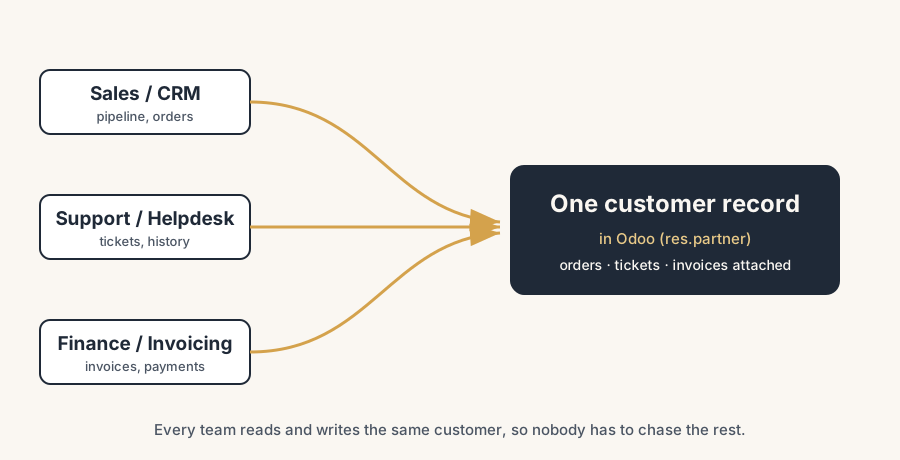
The principle is simple. There is one record per customer, and every interaction (the orders, the quotes, the tickets, the invoices, the calls) attaches to that one record. Anyone who opens it sees the whole history in one place, without asking a colleague. The customer stops being the integration.
Here is how to get there.
Decide there is one customer record, and which system holds it
Pick the system that owns the customer record and make it the one everyone reads from. In an integrated platform that is the central contact: every order, ticket and invoice links back to it. This sounds obvious, but most fragmentation exists precisely because three systems each think they own "the customer" and nobody decided which one is the real one. Decide first. And accept that duplicates will still slip in: a webshop guest checkout here, a fast-typed contact there. Odoo's data-cleaning tools exist for exactly that. Merge the duplicates and the orders, tickets and invoices come back together on the surviving record, so an accidental double never has to become two permanent half-customers. We make that merge check a routine at clients, not a rescue operation.
Put sales, support and finance on the same platform
The reason teams cannot see each other's work is that the work lives in separate tools. The fix is to run them on one platform where CRM, sales, invoicing and helpdesk all read and write the same customer record. In Odoo, a contact carries its own sales orders, invoices and helpdesk tickets, because they are all linked to the same res.partner. Open the customer and the history is already there. There is nothing to assemble, because it was never split.
Make every interaction attach to the customer, not float free
A ticket with no customer on it, an invoice booked to a generic "walk-in", a quote tied to a person who left: these are the gaps that recreate the fragmentation inside one system. Make it standard that every order, ticket and invoice names the real customer. Then the customer record stays complete, and the 360 view is actually 360.
Give each team the view they need on that one record
A single record does not mean everyone sees a wall of everything. Sales needs the pipeline and the order history. Support needs open tickets and recent orders. Finance needs invoices and payment status. On one platform you show each team the slice they need, drawn from the same record, so they act on the same facts without drowning in each other's detail.
Connect the systems you cannot move, with a sync layer
Some systems will stay separate: a marketplace, a specialist tool, an accounting package finance will not give up. Connect those with a real integration so the customer record stays in agreement across them, rather than letting a person paste between tabs. The reliable shape is a sync layer that holds the mapping in one place and keeps the systems aligned. The goal is one true customer, even across the systems you could not consolidate.
The part that trips people up
A few things catch almost everyone
A few things catch almost everyone.
The chase cost is invisible because it is spread across everyone. No single person spends a whole day relaying information, so it never looks like a problem worth fixing. It is fifteen minutes here and a callback there, across the whole team, every day. Added up it is large, but because it is diffuse, the project to fix it never gets approved.
Connecting tools is not the same as one customer record. You can wire a CRM to a helpdesk and still have two different customer records that never quite match, because you synced the interactions but never agreed on the identity. Decide which system owns the customer first, then connect, or you just sync confusion faster.
A shared dashboard is not a single view. A report that pulls from three systems once a night looks like a 360 view, but the agent on a live call needs the truth now, on the customer in front of them, not in last night's export. The view has to live on the record the team actually works in.
"We will just communicate better" does not scale. Better internal communication still means a person interrupting a person to fetch a fact a system already holds. The point is to remove the chase, not to make the chase faster.
Quick checklist
- You decided there is one customer record, and which system holds the real one.
- Sales, support and finance can all see the same customer history without asking each other.
- Every order, ticket and invoice is linked to the real customer, not to a generic or empty contact.
- A support agent can see this customer's orders and invoice status while on the call, not tomorrow.
- A salesperson can see open complaints before walking into a renewal.
- Systems you could not consolidate are kept in agreement by a real integration, not by a person pasting.
- The customer is never asked to repeat information your systems already hold.
FAQ
What is a single view of the customer?
A single view of the customer means there is one record per customer, and every interaction with them (orders, quotes, support tickets, invoices, calls) is linked to that one record. Anyone who opens it sees the whole history in one place. It matters because when sales, support and finance each hold a separate piece, the customer ends up repeating themselves and waiting while your team relays information internally.
Why do customers have to repeat themselves to different teams?
Because each team works in a different system that holds only its slice of the customer. Support sees tickets but not orders, finance sees invoices but not complaints, sales sees deals but not support history. None of them can see the whole, so they ask the customer to fill the gap. The fix is one customer record that all three teams read from, so the information is already there before the customer says it.
Can Odoo give one 360 view of the customer?
Largely, yes. Odoo runs CRM, sales, invoicing and helpdesk on the same database, and every order, invoice and helpdesk ticket links to the same customer contact. Open a customer and you see their orders, their invoice and payment status, and their open tickets in one place, because it is one record, not three systems stitched together. Systems that stay outside Odoo are connected with an integration so the customer record stays in agreement there too.
How do I stop sales, support and finance from working off different information?
Put them on one platform where they read and write the same customer record, and decide which system owns that record before connecting anything. Inside one Odoo, sales orders, invoices and helpdesk tickets already share one customer contact, so the teams act on the same facts. For any system that has to stay separate, connect it with a real integration so the customer record does not drift apart, rather than relying on people to relay information by hand.