
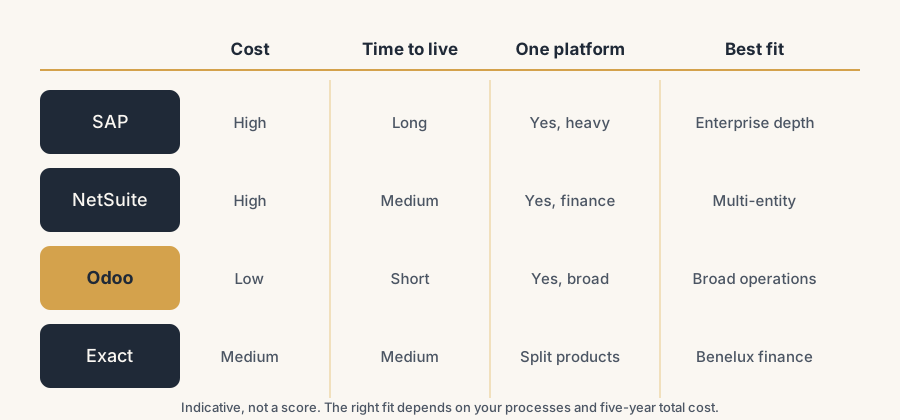
The short version up front: all four can run a 20 to 200 person company. Odoo usually wins on breadth for the money and joined-up operations, NetSuite on multi-entity finance, SAP on enterprise-grade depth, Exact on Benelux accounting. Which one is right depends on your hard part and your five-year total cost, and that is what this comparison walks through.
You run a company of 60 people. The spreadsheets that held everything together for years now break weekly, the webshop and the accounting package disagree about stock, and three different tools each claim to be the source of truth. So you start looking at ERP, and within a week four names keep coming back: SAP, NetSuite, Odoo and, if you are in the Netherlands or Belgium, Exact. Every vendor's site says they are the perfect fit for a growing mid-market business. They cannot all be right.
This article is not a sales pitch for any of them. It is the comparison we wish more buyers had before they signed. We will look at what actually matters for a 20 to 200 person company: the real total cost, how long it takes to go live, whether you get one platform or a bundle of separate packages, and where each system genuinely wins and loses. By the end you should know which two to shortlist, not which logo is biggest.
First, be honest about your own size and shape
The right ERP depends less on the vendor than on you. Before comparing anything, pin down three things.
How standard are your processes? If you sell, buy, stock and invoice in fairly normal ways, almost any of these systems can run you well, and the cheaper, faster option wins. If you have genuinely unusual logic that drives your margin, you will pay for it whichever system you pick, and the question becomes which one bends without breaking.
How many countries, entities and currencies? A single Dutch company with one webshop is a different animal from a group with five legal entities across three countries. Multi-entity consolidation, local tax rules and intercompany flows are where the heavier systems earn their price, and where the lighter ones make you work.
Where does your complexity actually sit? Serial-number manufacturing, multichannel retail with stock in five places, or project-based services each stress a different part of an ERP. Name your hard part first. The comparison below only makes sense against it.
The four, in one paragraph each
SAP. Two different products share the name. SAP Business One targets smaller companies; SAP S/4HANA is the enterprise platform. For a 20 to 200 person firm you are almost always looking at Business One, often through a local SAP partner. It is mature, deep in finance and manufacturing, and trusted by larger customers up the chain who may expect their suppliers to run it. It is also the heaviest to implement and customise of the four, and the licensing and partner model is the least transparent. You rarely buy SAP, you buy a partner's SAP project.
NetSuite. Oracle NetSuite is a true cloud suite, born online, strong in finance, multi-entity consolidation and companies that plan to scale or get acquired. If you are private-equity backed or heading for multiple entities and countries, it is a serious contender. The trade-offs are cost and rigidity: pricing is quote-based and renews annually (often upward), and you adapt to NetSuite's way more than it adapts to you. It is rarely the cheapest and rarely the fastest, but it is built to grow with a finance-led company.
Odoo. A broad suite of modules (sales, inventory, manufacturing, accounting, CRM, ecommerce, POS and more) on one data model, available as open-source Community or paid Enterprise. Its draw is breadth for the price and flexibility: one platform covering most of what a mid-market company needs, at a fraction of the per-user cost of the others, with an editor (Studio) and a developer ecosystem to adapt it. The trade-offs are that depth varies by module, the open flexibility makes it easy to over-customise, and quality depends heavily on the partner who implements it.
Exact. A Dutch accounting and ERP vendor, strong and well known in the Benelux, especially for finance and for accountants who already work in it. Exact Online is the cloud accounting and lighter-ERP line; the heavier ERP capability sits in separate products, and the wholesale/trade and manufacturing strengths are split across different Exact products rather than one suite. If your centre of gravity is Dutch accounting and your operations are relatively standard, Exact is comfortable and local. If you need deep operations and one joined-up platform, the split between products starts to show.
Total cost: what you actually pay, not the sticker
License price is the smallest part of the bill, and it is the part vendors lead with. For a mid-market ERP, implementation, data migration, training and the changes you make in year two usually cost more than the software itself. Treat any per-user figure as the tip of the iceberg.
With that warning, the rough shape in mid-2026 looks like this. Odoo publishes its prices: the Standard plan is around 30 US dollars per user per month and the Custom (Enterprise) plan around 60, billed yearly, varying by country. SAP Business One sits roughly in the 80 to 120 per user per month range; SAP S/4HANA starts higher, around 200 and up. NetSuite does not publish prices: a common mid-market shape is a base platform fee in the order of 999 dollars a month plus roughly 100 to 130 per full user, all negotiated. Exact prices its Online subscriptions per package and add-on rather than a simple per-seat ERP rate, and the heavier ERP is quote-based.
Per-user numbers only tell you the entry fee. The number that decides your budget is the implementation. As a rule of thumb across the heavier systems, licenses are only about a third of the first-year spend and implementation is the rest. A mid-market NetSuite or SAP Business One implementation commonly lands somewhere in the tens to low hundreds of thousands, depending on entities and customisation. Odoo implementations tend to come in lower for a comparable scope, partly because the software is cheaper and partly because a disciplined Odoo build leans on standard configuration rather than custom code. That gap narrows fast if you customise Odoo heavily, which is exactly the trap to avoid.
The cost summary is honest but unsatisfying: Odoo is usually the cheapest to license and often the cheapest to implement for a standard scope. NetSuite and SAP cost more up front and more per year, and you are paying partly for depth and partly for the brand and ecosystem. Exact sits in between for Benelux finance-led companies. None of these prices mean anything until a partner has scoped your actual processes, because scope, not the price list, sets the bill.
<em>Prices are indicative for mid-2026 and vary by country, scope and negotiation. SAP, NetSuite and the heavier Exact products are quote-based.</em>
Time to go live
Speed tracks complexity and discipline more than the brand on the box. A focused implementation of a standard scope (sales, purchasing, inventory, accounting) can go live in two to four months on Odoo or NetSuite. Add manufacturing, multiple entities, several integrations or heavy customisation and any of these systems will take six months to a year or more.
SAP Business One and S/4HANA projects tend to run longest, because the projects that choose SAP are often the more complex ones and the implementation model is more involved. NetSuite mid-market projects commonly run three to six months. Odoo can be fast when the team holds to standard, and slow when every meeting adds another "small" customisation. The pattern to watch is the same everywhere: the timeline is set by how far you drift from the standard system, not by the vendor's marketing.
One platform or a bundle of packages
This is where the systems differ in a way the price list hides, and it matters more than most buyers expect.
Odoo's pitch is one platform: sales, inventory, manufacturing, accounting, CRM, ecommerce and POS share one database and one data model, so an order, the stock move and the invoice are the same chain of records, not three systems passing files. That is genuinely valuable when your problem is that your current tools disagree with each other. The risk is that breadth tempts you to switch on more than you need.
NetSuite is also a single suite, finance-first, and joins up cleanly for a company whose centre of gravity is the books and multi-entity reporting. Its operational depth (warehouse, manufacturing) is real but is where you pay and where you bend to its way.
SAP can be one platform too, but the depth comes with weight, and reaching that depth in Business One often means partner add-ons on top.
Exact is the clearest example of the split. Its strengths in trade and wholesale on one hand and in manufacturing on the other live in different products rather than one suite, and the cloud accounting line is separate again from the heavier ERP. For a finance-led Dutch company that is fine. For a company that wants stock, production and the webshop to be one joined-up flow, stitching Exact products together starts to feel like the very problem you set out to solve. Ask any vendor directly: is this one platform, or several products with connectors between them, and who keeps those connectors working at the next upgrade.
Where each one wins, and where it loses
SAP wins when you are at the larger end (closer to 200 than 20), have complex finance or manufacturing, sell to enterprises who expect SAP in the chain, or want the safest-sounding name in the boardroom. SAP loses on cost, speed and transparency, and it is usually overkill for a 30-person standard operation.
NetSuite wins for finance-led companies, multi-entity groups, and anyone planning to scale fast or get acquired, where clean consolidated reporting across countries pays for itself. NetSuite loses on price predictability (quote-based, annual renewals that tend to rise) and flexibility, and it can be heavy for a single-entity operational business.
Odoo wins on breadth for the price, on flexibility, and on being one joined-up platform for a broad mid-market operation: multichannel retail, wholesale across channels, or series manufacturing. It is often the best fit for the 20 to 200 band specifically. Odoo loses when you treat its openness as a licence to customise everything (the cost and upgrade pain then catch up with the others), when a module is shallower than a best-of-breed specialist, or when a weak partner implements it badly. With Odoo, the partner is the product.
Exact wins in the Benelux for finance-led companies, especially where your accountant already lives in Exact and your operations are standard. Exact loses when you need deep, joined-up operations across stock, production and sales in one platform, because its strengths are split across separate products.
How to actually decide
Run your shortlist through four questions, in this order.
What is my hard part?
Finance and multi-entity consolidation point toward NetSuite or Exact. Broad joined-up operations across sales, stock, production and channels point toward Odoo. Enterprise-grade complexity or an enterprise customer base point toward SAP.
How standard am I, honestly?
The more standard your processes, the more the cheaper and faster option wins, which favours Odoo or Exact. The more genuinely unusual your margin-driving logic, the more you should test how each system bends, and budget for it.
What is the five-year total cost, not the per-user price?
Make every vendor scope the same process list and quote license plus implementation plus a realistic year-two change budget. Compare those totals, not the sticker. And scope against where you are going, not only where you are. An ERP is a five to ten year commitment, so the requirements list must cover the whole period: the second warehouse, the next country, the B2B portal you plan for year three. A system that fits today and chokes at twice your size was the wrong choice on day one; you just could not see it yet.
Who implements it, and can I see their work?
For all four, but especially Odoo, the partner decides whether you get a clean system or an expensive mess. Talk to two of their reference clients your size before you sign anything. If you only remember one thing: shortlist two, scope the same processes with both, and compare the real five-year number. The logo matters far less than the fit and the partner.
Quick checklist
- You have named your hard part (finance, operations, manufacturing, multichannel) before comparing vendors.
- You counted entities, countries and currencies, not just headcount.
- You judged total cost over five years (license plus implementation plus year-two changes), not the per-user price.
- You asked each vendor plainly whether it is one platform or several products with connectors.
- You separated "how standard are we" from "how big are we", because they drive different choices.
- You checked two reference clients of the partner who would actually implement it.
- You shortlisted two systems and scoped the same processes with both before deciding.
FAQ
Is Odoo a real alternative to SAP and NetSuite for mid-market?
Yes, for most 20 to 200 person companies. Odoo covers the same core (sales, inventory, manufacturing, accounting, CRM, ecommerce) on one platform at a far lower per-user cost, and is often cheaper and faster to implement for a standard scope. SAP and NetSuite pull ahead when you need enterprise-grade finance depth, complex multi-entity consolidation, or an enterprise customer base that expects those names. The decision should turn on your hard part and your five-year total cost, not the brand.
Which ERP is cheapest for a mid-market company?
Odoo is usually the cheapest to license and often the cheapest to implement for a standard scope, with published per-user prices (around 30 US dollars per user per month on Standard, around 60 on Custom in mid-2026, varying by country). SAP Business One, NetSuite and the heavier Exact products cost more and are quote-based. But license price is the small part: implementation, migration and year-two changes usually cost more than the software, so compare full five-year totals, not per-user rates.
How long does a mid-market ERP implementation take?
A focused, standard scope (sales, purchasing, inventory, accounting) can go live in roughly two to four months on Odoo or NetSuite. Add manufacturing, multiple entities, several integrations or heavy customisation and any of these systems takes six months to a year or more. SAP projects tend to run longest. Timeline is driven by how far you drift from the standard system, not by the vendor.
Is Exact one platform or several products?
Several. Exact's strengths in trade and wholesale and in manufacturing live in different products, and its cloud accounting line is separate again from the heavier ERP. For a finance-led Dutch company with standard operations that is fine. If you want stock, production and sales joined up in one platform, the split between Exact products is a real consideration, and you should ask who keeps the connectors between them working at each upgrade.
Should I pick the ERP my accountant or my biggest customer uses?
It is a factor, not the deciding one. If your accountant lives in Exact or a large customer expects SAP in the supply chain, that lowers friction and is worth weighing. But the system has to fit your own processes and total cost over five years first. Choosing an ERP mainly to please an outside party is how companies end up with software that is heavy and expensive for what they actually do.