
You grow without growing headcount by breaking the link between order volume and admin: capture each order once at the source, let it flow to delivery and invoice without re-entry, and automate the checks. The hours per order drop to minutes, and volume stops dictating staffing.
Sales are up twenty percent and you are happy until you look at the office. Two people are typing orders that came in by email into the order screen. Someone else is copying tracking numbers from the carrier into a spreadsheet so they can answer "where is my order" calls. A fourth person is checking, by hand, whether a customer is over their credit limit before the warehouse ships. Every one of those jobs grew with the orders, and the obvious answer is the expensive one: hire another person.
That is the trap. When each new order adds the same fixed amount of admin, your back office grows in lockstep with your revenue, and your margin does not move. You are bigger and busier and no more profitable. The good news is that the link between order volume and headcount is not a law of nature. It exists because the work is manual and the data lives in too many places. Break those two things and you can take a lot more orders through the same team. Here is where the hours actually leak, why it happens, and what a setup looks like that does not need a new hire for every growth spurt.
Why admin scales with growth
Most back-office work is linear. An order that takes seven minutes to process by hand takes seven minutes whether it is your tenth order or your thousandth. Double the orders and you double the minutes, so you double the people. The cause is almost never laziness or bad staff. It is that the work is done by humans moving data that a computer should be moving.
The same data gets entered more than once. An order arrives by email or in the webshop, someone types it into the sales screen, someone else re-types the address onto the shipping label, and the figures get keyed again into the accounting package. Each re-key is a person doing what a connected system does for free, and each one is a chance to make a typo that turns into a wrong delivery and an angry call.
Status lives in people's heads and inboxes. "Has this been picked? Is it invoiced? Did the customer pay?" When the answer is in someone's memory or buried in an email thread, every question becomes an interruption. The bigger you get, the more of these questions fly around, and chasing status quietly becomes a full-time job that nobody planned for.
Checks are done by hand, every time. Is this customer over their credit limit? Is this the right price for this customer? Is there enough stock to promise this date? When a human checks each one, the check is only as reliable as how busy that human is that afternoon, and it does not scale: more orders mean more checks mean more people checking.
Every system is an island. The webshop does not know what the warehouse knows. Accounting does not know what sales agreed. So people become the bridges between the islands, ferrying data back and forth by copy-paste and email. The more islands, the more ferrying, and the ferrying is pure cost: it adds no value, it just moves numbers from one screen to another.
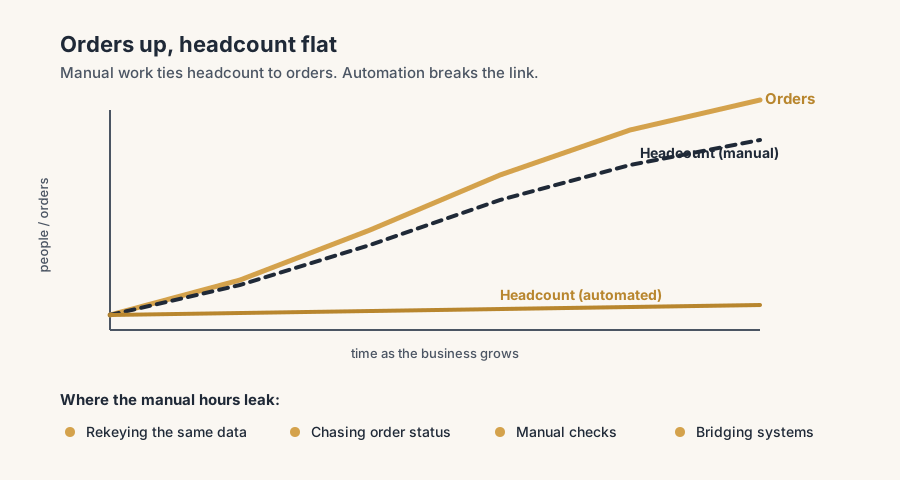
How one connected system breaks the link
The fix is not "work harder" or "hire ahead of growth". It is to make the order enter once, flow through every step on its own, and only stop for a human when a human actually needs to decide something. Two ideas do the heavy lifting: one place where the data lives, and automation that carries the order between steps. Here is the approach, and how Odoo handles each part.
Capture the order once, at the source.
The hour leaks at the very first step when someone re-types an order that already exists somewhere as text. The fix is to let the order land directly in the system: the webshop writes the sales order itself, B2B customers order through a portal, and email or EDI orders come in through a connector instead of a keyboard. In Odoo the webshop and the sales order are the same system, so a web order is already a sales order with no re-keying. The reason this matters: every re-key you remove is both an hour saved and an error you will never have to fix.
Let the order flow through to delivery and invoice without re-entry.
Once the order exists once, every downstream step should read from it, not copy it. The confirmed order becomes the delivery instruction in the warehouse and the basis for the invoice, with the same product, quantity and address carried through automatically. In Odoo, confirming a sales order creates the delivery order in Inventory and the draft invoice in Accounting from the same record. Nobody re-types the address onto the label or the totals into the books. The reason this matters: the work that used to take three people typing now takes one person clicking confirm.
Automate the checks so they happen on every order.
The credit-limit check, the right price for this customer, the reorder when stock runs low: these are rules, and rules belong to the computer. In Odoo a price list applies the agreed price per customer automatically, a credit limit can warn or block before shipping, and reordering rules raise a purchase order when stock hits its minimum. The check runs the same way on order one and order one thousand. The reason this matters: the check stops being a person's job and becomes a property of the system, so growth does not add checkers.
Make status visible so nobody has to chase it.
When the order, the delivery, the invoice and the payment all hang off one record, "where is my order" is a glance, not an investigation. In Odoo the sales order shows its delivery status and invoice status on the same screen, and the customer portal lets the customer see it themselves. The reason this matters: every status question you answer with a glance instead of a five-minute hunt is time that does not grow with volume.
Connect the islands once, properly, instead of bridging them with people.
If you genuinely need a separate webshop, marketplace or warehouse system, connect it so data flows automatically, rather than having staff copy between them. The aim is one source of truth that every system reads from and writes to, so a sale anywhere updates stock everywhere without a human in the middle. The reason this matters: a person bridging two systems is a cost that scales with orders; a connection that does it automatically is a cost you pay once.
The part that trips people up
A few things catch almost everyone
Automation only pays off on a clean, standard process. If your order flow has twenty exceptions and three "we always do it differently for this customer" rules, automating the mess just makes the mess run faster. Simplify the process first, then automate it. The companies that break the link are usually the ones who were willing to drop a few habits, not the ones who automated every quirk.
The goal is not zero people, it is people on the right work. Automation does not empty the office. It moves your team off rekeying and chasing status and onto the work that actually needs a human: a tricky customer, a supplier problem, a decision. If you measure success by "did headcount drop", you will miss the real win, which is taking double the orders with the same team and a calmer office.
"We'll fix it when we're bigger" is backwards. Manual processes are easiest to change when volume is low. The busier you get, the more the daily firefighting eats the time you would need to fix the system, so the problem hardens exactly as it gets more expensive. The cheapest time to break the link is before you are forced to hire.
Beware the false economy of a cheap connector. Bridging your webshop and your ERP with a brittle point-to-point link can save a person today and cost you a week every time something upstream changes or you upgrade. A connection is only a saving if it keeps working without someone babysitting it.
One real number anchors it: if processing an order by hand takes seven minutes and you do two hundred orders a day, that is over twenty hours of pure typing a day, roughly three full-time people whose entire job is moving data a computer could move. That is the headcount the link is forcing on you, and it is the headcount that automation gives back.
We watched this play out at a client running a physical store next to a webshop, on two systems that were never properly connected. Most of the office day went into manual work between the two. After moving both onto Odoo, the company grew another 20 percent without hiring a single extra person for the back office. The growth went into margin instead of into vacancies.
Quick checklist
- Orders enter the system once, at the source (web, portal, connector), and are not re-typed by hand.
- Confirming an order creates the delivery and the draft invoice from the same record, with no re-entry.
- Pricing per customer, credit limits and reordering run as automatic rules, not manual checks.
- Order, delivery, invoice and payment status are visible on one screen and to the customer in a portal.
- Separate systems are connected so data flows automatically, not bridged by people copying between them.
- The process was simplified before it was automated, so you automated a clean flow and not a mess.
- You can name the few decisions that still need a human, and everything else runs on its own.
FAQ
How do I grow my business without hiring more admin staff?
Break the link between order volume and manual work. Most back-office hours go into rekeying the same data between systems, chasing order status, and doing manual checks. Capture each order once at the source, let it flow automatically to delivery and invoicing, turn the checks (pricing, credit limit, reordering) into automatic rules, and connect your systems so nobody copies data by hand. In Odoo, a web order is already a sales order, confirming it creates the delivery and draft invoice, and price lists and credit limits apply on their own. The same team then handles far more orders.
Where do the admin hours actually go when sales grow?
Three places. First, rekeying: the same order typed into the sales screen, then the shipping label, then the accounting package. Second, chasing status: answering "is it picked, invoiced, paid" when the answer is in someone's head or inbox. Third, manual checks: verifying the price, the credit limit or the stock by hand on every order. All three scale linearly with volume, which is why headcount rises with revenue unless you automate them.
Will automating my order process mean laying people off?
Usually not. The point is to take more orders with the team you have, not to shrink it. Automation moves people off rekeying and status-chasing and onto work that needs a human: tricky customers, supplier problems, decisions. Most growing companies do not cut headcount, they stop adding it, so the same people handle double the volume and the office stays calm instead of frantic.
Can Odoo handle order processing without lots of manual entry?
Yes, when it is set up as one connected system. The webshop and the sales order are the same record, so web orders need no rekeying. Confirming a sales order creates the delivery in Inventory and the draft invoice in Accounting automatically. Price lists apply the right price per customer, credit limits can warn or block before shipping, and reordering rules raise purchase orders when stock runs low. The manual work that scaled with growth becomes a rule the system runs the same way every time.