
The way to stop retyping orders is to enter each order once at the source and let it flow to every other system on its own: the ERP as the hub, and an iPaaS sync layer connecting whatever stays outside it. Everything below is the maths of what retyping costs and the steps to get there.
An order comes in on the webshop. Someone copies it into the ERP by hand. Someone in finance retypes it into the accounting package. Someone in the warehouse keys the same address into the shipping tool. The same order, typed four times, by four people, into four systems. Every one of them is a chance to fat-finger a quantity, drop a line, or ship to the old address.
This is the quiet tax most growing companies pay without noticing. It does not show up as one big bill. It shows up as an hour here, a wrong delivery there, a customer who got billed twice. Add it up across a year and it is a salary. Here is what the retyping actually costs, why it keeps happening, and how to stop it for good.
Why the retyping happens
Nobody planned it this way. It grew. You started with a webshop. Then you added an accounting package because the bookkeeper knew it. Then a warehouse picked a shipping tool. Then sales wanted a CRM. Each system was a sensible choice on its own day. None of them were chosen to talk to the others.
So the only thing connecting them is a person with a keyboard. The webshop does not know your ERP exists. The ERP does not push to accounting. The shipping tool waits for someone to paste in an address. The "integration" is human, and humans are slow and they make mistakes, especially when the work is dull and repetitive.
The deeper problem is that there is no single place where an order is true. The webshop thinks one thing, the ERP another, accounting a third. When they disagree, and they will, nobody knows which one is right.
What it actually costs
Two costs, and the second is worse than the first.
The time cost. Say an order takes three minutes to retype across the chain, and you do 60 orders a day. That is three hours a day of pure copying, every day, with nothing produced. Over a year that is the better part of a full-time job spent moving data that the systems could have moved themselves. The people doing it are usually your more capable staff, because you need someone who understands an order to retype one safely.
The error cost. This is the expensive one. Manual data entry has an error rate. Industry studies put it around 1 percent per keystroke-heavy field, and an order has many fields. At 60 orders a day that is several wrong orders every week: a quantity that became 100 instead of 10, an old delivery address, a price typed without the discount. Each wrong order has a tail: the wrong goods ship, the customer calls, someone investigates, you ship again, you write off the first shipment, you issue a credit note. The retyping took three minutes. The mistake takes half a day and a piece of the customer's trust.
There is a third cost that never makes the spreadsheet: the decisions you make on numbers that are already wrong. If the webshop, the ERP and accounting each hold a slightly different version of the truth, every report built on top of them is slightly off, and you do not know by how much.
The fix is entering data once and letting it flow
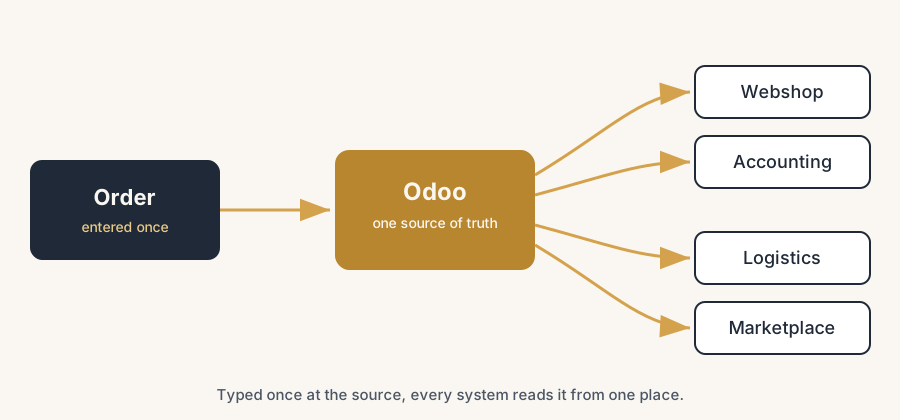
The principle is simple. Data is entered once, at the point it is created, and every other system reads it from there instead of from a human retyping it. One source of truth. The order is captured on the webshop, lands in the ERP automatically, and the ERP feeds accounting and logistics. No second typing, no third, no fourth. Here is how to get there.
Pick the system that owns each kind of data.
Before you connect anything, decide where each thing is true. Orders are true in the ERP. Stock is true in the ERP. The customer record is true in the ERP or the CRM, pick one. Invoices are true in accounting. Write it down. This sounds obvious, but most retyping exists precisely because two systems both think they own the same data and nobody decided which one wins.
Capture the order once, at the source.
The order should enter your systems exactly once, where it is created. For a webshop order that is the webshop. For a phone order that is the ERP or CRM. From that single capture, everything downstream is fed automatically. The person who takes the order is the only person who ever types it.
Let the ERP be the hub.
Odoo is built to be the place orders, stock, invoicing and deliveries live together. A webshop order becomes a sales order, the sales order creates the delivery, the delivery confirms and the invoice draws from the same order. Inside one Odoo, the data already flows without any retyping, because it is one database. The retyping only survives where a system sits outside Odoo.
Connect the outside systems with a sync layer, not a person.
For the systems that stay separate (a marketplace, a specialist WMS, an accounting package finance will not give up), connect them with a real integration so data moves automatically. The reliable shape for this is a sync layer that holds the mapping and the rules in one place and keeps the systems in agreement, rather than a fragile point-to-point link or, worse, a person pasting between tabs. The goal is that an order entered once reaches every system that needs it, without a keyboard in the middle. In practice that shape is an iPaaS: a dedicated integration layer with monitoring, retries and one place to change a rule. We run one ourselves, System2System, and the difference with hand-built links shows at every upgrade: the layer absorbs the change instead of the connection breaking.
Make the flow visible.
Add monitoring so you know when an order does not make it across. The failure mode of a silent integration is the same as the failure mode of retyping: you find out from the customer. A flow you can see is a flow you can trust.
The part that trips people up
A few things catch almost everyone
The error cost is invisible until you look for it. The three minutes of retyping is visible; the wrong shipment three weeks later is filed under "warehouse mistake" or "customer error", not under "retyping". Nobody connects the two, so the real cost of the manual link never gets counted, and the project to fix it never gets approved.
"We will just be careful" does not scale. Manual entry has an error rate that does not go to zero no matter how good your people are, and it gets worse when they are busy, which is exactly when volume is high and mistakes hurt most. You cannot train your way out of a process that requires perfect typing forever.
Connecting systems is not the same as having one source of truth. You can wire two systems together and still have them disagree if you never decided which one owns the data. Decide ownership first, then connect. A connection on top of an undecided ownership question just moves the confusion faster.
A spreadsheet in the middle is still retyping. Exporting from one system to a spreadsheet and importing into the next feels automated, but a person still touches every row, and every touch is an error chance. It is retyping with extra steps.
Quick checklist
- You decided which system owns each kind of data (orders, stock, customers, invoices).
- An order is typed by a person exactly once, at the point it is created.
- Inside the ERP, orders, deliveries and invoices draw from the same record, not separate entries.
- Outside systems are connected by a real integration, not by someone pasting between tabs.
- There is no spreadsheet step where a person retypes rows from one system into another.
- You can see when an order fails to cross between systems, before the customer tells you.
- You have estimated the time cost (minutes per order times orders per day) and the error cost (wrong orders per week times the cost to fix one).
FAQ
How much does manual order entry really cost?
More than the time it takes, because of errors. The time cost is minutes per order times orders per day: at three minutes and 60 orders a day, that is three hours a day of pure copying. The error cost is usually larger. Manual entry has an error rate of roughly 1 percent on data-heavy fields, so at that volume you get several wrong orders a week, and each wrong order costs far more to fix than the few minutes it took to type. The hidden third cost is decisions made on reports that disagree because each system holds a different version of the order.
How do I stop my team retyping orders between the webshop, ERP and accounting?
Enter each order once, at the point it is created, and let every other system read it from there instead of from a person. Inside one ERP like Odoo, orders, deliveries and invoices already share one database, so there is no second typing. For systems that stay separate, connect them with a real integration so data moves automatically. First decide which system owns each kind of data, then connect, so the systems agree instead of just syncing faster.
What is a single source of truth and why does it matter for orders?
A single source of truth means each kind of data lives in exactly one system, and every other system reads it from there. For orders it matters because when the webshop, the ERP and accounting each hold their own version, they drift apart, and nobody knows which is right. With one source of truth the order is captured once and the same record feeds delivery, invoicing and reporting, so there is nothing to retype and nothing to reconcile.
Can Odoo remove the need to retype orders?
Largely, yes. Odoo runs orders, stock, invoicing and deliveries in one database, so an order entered once flows to the delivery and the invoice without any retyping. The retyping only survives where a system sits outside Odoo, for example a marketplace or a separate accounting package. Those are connected with an integration so data moves automatically, which removes the manual link there too.