
AI on a messy ERP fails because it scales whatever it finds, wrong answers included. Get to one source of truth, consistent master data and standard processes first, and only then switch AI on, narrowly, where the data is solid.
You switch on the new AI features in Odoo 19. You ask the assistant to list your top customers by margin, and it answers in seconds. The number is wrong. Two of those customers are the same company entered twice, once as "Acme BV" and once as "ACME b.v.". A third is a one-off that got tagged as a key account by mistake. You ask the AI to suggest reorder quantities, and it proposes ordering a product you stopped selling last year, because nobody archived it. The demo looked magic. On your own data it makes confident mistakes.
This is the pattern almost everyone hits. The AI is not broken. It is reading the database you actually have, with its duplicate contacts, three SKU formats, half-filled fields and stages that mean different things to different teams. AI does not fix messy data. It scales whatever is already there, fast and with a straight face. The order is the whole point: first the standard, then AI. Get one clean source of truth and consistent processes in place, and the same AI that embarrassed you becomes genuinely useful. Here is what "clean standard" means in concrete terms, why AI fails without it, and the practical path to get your Odoo AI-ready.
Why AI on messy data fails
An AI assistant, an AI field or an AI agent does the same thing a good analyst would do, except it never questions the source. It reads your records, finds patterns, and acts. If the records are clean, that is powerful. If they are not, the AI inherits every flaw and presents it with the same confidence as a correct answer. There is no warning label that says "this total is wrong because of duplicates".
Three problems poison AI output more than any others. Duplicates make every count and total wrong, because the same customer, product or vendor is two records that the AI treats as two things. Inconsistent values break grouping and filtering: if "Netherlands", "NL" and "The Netherlands" all live in your country field, no AI report can group them correctly. Empty or misused fields leave the AI guessing: an "Ask AI" report on customer industry is worthless if half your contacts have no industry set, or if people typed the industry into the notes instead of the field.
The deeper issue is that AI removes the human pause. When a person pulls a report and sees a number that looks off, they stop and check. An AI agent that auto-creates a purchase order, drafts a reply or fills a field does not pause. It acts on the data as written. So the cost of messy data, which used to be a slow drip of small errors people caught by hand, becomes fast and automatic. That is why the standard has to come first. You are not just feeding AI better numbers, you are removing the place where bad numbers turn into bad actions.
What a clean standard means
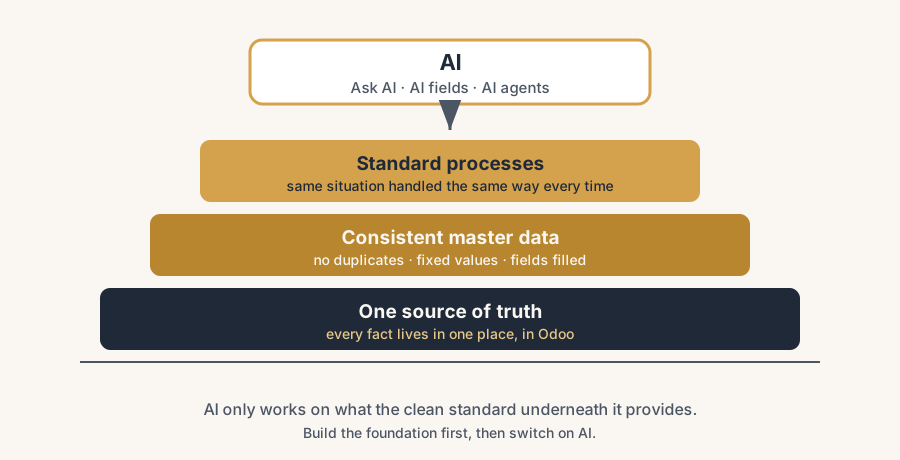
"Clean standard" is not a vague aspiration. It is three concrete things, in this order.
One source of truth
Every important fact lives in exactly one system, and everything else reads from it. Your customer master, your product catalogue, your stock levels, your orders: each has one home, which is Odoo. The webshop does not keep its own separate customer list. The warehouse spreadsheet does not hold a second stock count. When a fact lives in two places, the two will drift apart, and then no AI (and no human) can tell you which one is true. One source of truth is the foundation because AI has to read from somewhere, and that somewhere has to be the one place that is right.
Consistent master data
Master data is the slow-changing core: customers, suppliers, products, the chart of accounts, units of measure. Consistent means the same thing is always written the same way and the right fields are filled. One naming convention for products. One way to write a company name. No duplicate contacts. Country, currency, customer type and other fields that AI groups and filters on are actually filled, with values from a fixed list rather than free text where it matters. This is the least glamorous work in any ERP and the highest-leverage for AI, because every count, total and grouping the AI produces depends on it.
Standard processes
A process is standard when the same situation is handled the same way every time, and the steps live in the system rather than in someone's head. A sales order moves through the same stages with the same meaning for everyone. An invoice gets booked the same way regardless of who books it. A new product gets created with the required fields filled, every time, because the form will not let you skip them. Standard processes are what keep the data clean after you have cleaned it, and they give AI a stable pattern to learn from and act within. AI is far more useful inside a predictable process than inside an improvised one.
Notice the order. One source of truth makes consistent master data possible. Consistent master data makes standard processes meaningful. The three together are the clean standard that AI sits on top of. Skip the standard and you are building AI on sand.
The practical path to AI-ready
You do not need a year-long cleanup before you touch AI. You need to clean the few things AI will actually read first, then switch AI on where the data is solid. Work in this order.
Pick one source of truth and turn off the rivals
Decide that Odoo holds the master for customers, products and stock, and stop the parallel lists. The webshop, the marketplace, the warehouse: each reads from or writes to Odoo, not its own copy. Where another system genuinely needs the data, sync it from Odoo rather than maintaining a second master by hand. This is the step people skip and the one that matters most, because every later cleanup is wasted if a second system keeps re-injecting mess.
Deduplicate and standardise your master data
Before any AI, clean the core records. Merge duplicate contacts (Odoo has a built-in duplicate merge for contacts). Pick one product naming convention and apply it. Replace free-text values with proper selection fields where AI will group on them, for example customer type, industry or region. Archive products, customers and price lists you no longer use so the AI does not treat dead records as live ones. This is unglamorous and it is the single highest-return task before AI. The twist is that AI is also the best cleaning tool you have. We use an assistant to hunt the duplicates, spot the odd SKU formats and propose the merges, because pattern-finding across thousands of records is exactly what it is good at. For now it proposes and a human approves; the oversight stays until the error rate has earned the trust. So the order is not "clean first, AI later" as two separate worlds. It is AI on the cleanup with a person in the loop, then AI on the answers.
Fill the fields AI depends on
Decide which fields your AI use cases actually read, and make those required. If you want AI to report margin by customer segment, the segment field has to be filled on every customer. If you want AI replenishment suggestions, lead times, reordering rules and supplier data have to be set. Make the fields that matter mandatory on the form so they get filled at creation, not "later".
Standardise the processes that feed AI
Lock down the few processes whose data the AI will use. Agree what each sales stage means and use it the same way across the team. Define how a product gets created, how an invoice gets booked, how a lead gets qualified, and put those rules into the system as required fields and clear stages rather than tribal knowledge. A standard process produces standard data, which is exactly what AI needs.
Switch on AI where the data is solid, narrowly
Now turn on AI, but only where you have done the work. Start with one use case on clean data: an "Ask AI" report on a well-maintained dataset, an AI field that enriches a record people already fill carefully, or an AI agent on a single tidy workflow. Check its output against reality before you trust it, and before you ever let an agent act automatically. Expand to the next use case only when its underlying data is as clean as the first. Narrow and verified beats broad and hopeful.
The part that trips people up
A few things catch almost everyone
A few things catch almost everyone.
The demo data is clean, yours is not. Every AI demo runs on a tidy sample database, which is why it looks magic. The gap between the demo and your result is almost always the gap between the demo's data and yours, not the AI. Judge AI on your data, not the showroom.
AI confidence is not AI accuracy. A wrong AI answer looks exactly as confident as a right one. There is no built-in flag for "this is based on duplicate records". Until you trust the underlying data, treat every AI output as a draft to verify, especially anything an agent does without a human in the loop.
Cleaning once is not enough without standard processes. You can deduplicate and standardise on a Saturday and watch the mess creep back by Friday, because the processes that created it are unchanged. The cleanup holds only if the process that feeds the data is standardised too. Otherwise you are mopping with the tap running.
More data is not better data for AI. Importing five years of history into Odoo "so the AI has more to work with" usually imports five years of inconsistency. AI does better on a smaller, clean dataset than a large, dirty one. Clean what you load, do not just load more.
Custom fields and customisations multiply the cleanup. Every bespoke field, odd workflow and one-off customisation is another place where data drifts and another thing the AI has to make sense of. The closer you stay to standard Odoo, the less there is to clean and the more predictable the AI behaves. Heavy customisation does not just slow upgrades, it makes the data harder for AI to use.
Quick checklist
- One system (Odoo) holds the master for customers, products and stock, and other systems read from it instead of keeping their own copy.
- Duplicate contacts, products and vendors are merged, with one naming convention applied.
- Values that AI groups on (country, customer type, industry, region) come from fixed selection fields, not free text.
- The fields your AI use cases actually read are filled, and required on the form so they stay filled.
- Dead products, customers and price lists are archived so AI does not treat them as live.
- The processes whose data AI uses are standardised, with clear stages and required fields, not tribal knowledge.
- AI is switched on narrowly, on one clean dataset at a time, with output verified before it is trusted or allowed to act automatically.
FAQ
Why does AI give wrong answers on my Odoo data?
Because AI reads the data you have, including its duplicates, inconsistent values and empty fields, and reports on it without questioning the source. If the same customer exists twice, every total that involves that customer is wrong, and the AI cannot tell. The fix is not a better AI, it is cleaner data: merge duplicates, standardise values, fill the fields the AI uses, and verify AI output against reality before you trust it.
What does "AI-ready data" actually mean?
It means three things, in order. One source of truth, so every important fact lives in exactly one system and everything else reads from it. Consistent master data, so customers, products and other core records are written the same way, free of duplicates, with the fields AI groups on actually filled. And standard processes, so the same situation is handled the same way every time and produces predictable data. AI sits on top of those three. Without them it scales the mess instead of solving it.
Should I clean my data before turning on Odoo AI, or after?
Before, but narrowly. You do not need to clean everything first. Clean the specific data each AI use case will read, then switch on that one use case and verify it, then move to the next. Trying to use AI on uncleaned data produces confident wrong answers, and trying to clean everything before touching AI stalls forever. Clean what AI will read, switch it on there, expand from solid ground.
Does staying close to standard Odoo help with AI?
Yes. Every custom field, bespoke workflow and one-off customisation is another place where data drifts and another thing the AI has to interpret. The closer you stay to standard Odoo, the less there is to clean, the more consistent the master data, and the more predictably the AI behaves. Heavy customisation makes both upgrades and AI harder. A clean standard is the foundation AI needs.