
Odoo vs Salesforce: Which CRM Actually Fits Your Business
A plain-language comparison of price, features and setup time, so you can decide with real numbers instead of sales pitches.
The Short Answer
Salesforce is the bigger, better-known name. Odoo is usually the cheaper one, and the faster one to get running. That is the short version of the Odoo vs Salesforce decision.
If you need one system that runs your whole business, not just your sales team, Odoo tends to win on total cost and setup time. If your sales team is large, sales is the only thing you need software for, and budget is not the limiting factor, Salesforce still offers more depth. The rest of this Odoo CRM review shows you the real numbers behind both of those statements, so you are not choosing based on a sales pitch from either side.
One App Versus a Platform of Apps
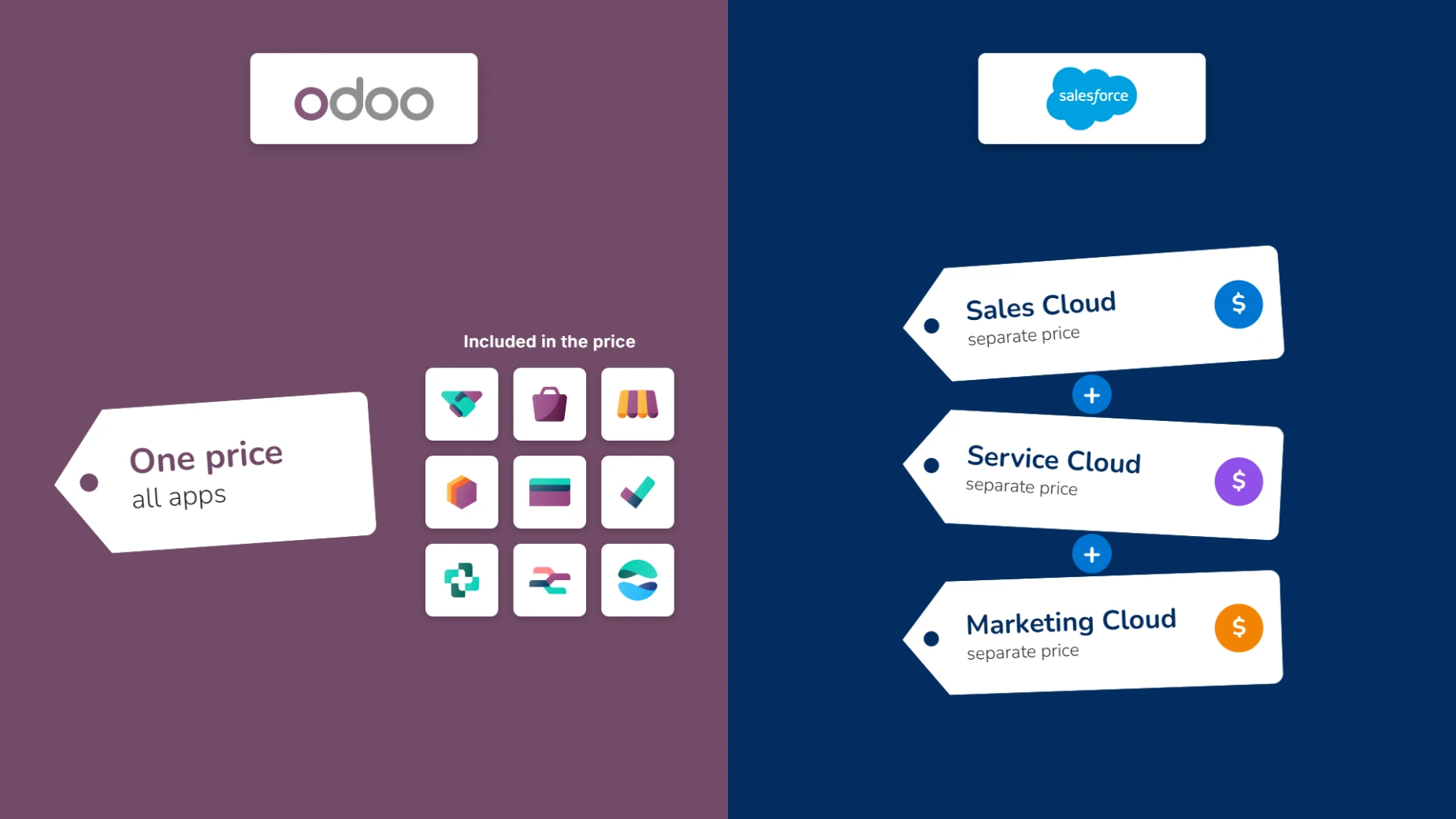
Salesforce started as a CRM and grew into a platform of separate products, usually called Clouds. Sales Cloud, Service Cloud, and Marketing Cloud are each their own product with their own price. You buy the ones you need and connect them.
Odoo started as the opposite idea: one all-in-one business suite, with CRM as just one of dozens of built-in apps, all under a single per-user price. Accounting, inventory, HR, a website builder, and CRM all live in the same system by default.
If you only ever need a CRM and nothing else, this difference will not matter much on day one. It starts to matter the moment your business also needs invoicing, stock tracking, or a website, because with Salesforce, every one of those is a separate product with its own bill. This is usually what people are really asking when they search Odoo vs Salesforce CRM: not which one has a better pipeline view, but which one keeps costing more as the business grows.
Odoo vs Salesforce Pricing, With Real Numbers
What Odoo Costs
Odoo CRM pricing is not sold as a separate product. It comes as part of Odoo's overall pricing, which has three tiers. One App Free gives you a single app, such as CRM, with unlimited users, for €0. Standard is approximately €22.91 per user per month billed yearly (or €28.61 billed monthly) and includes every Odoo app on Odoo Online. Custom is approximately €45.08 per user per month billed yearly (or €56.21 billed monthly) and adds Odoo Studio, multi-company support, external API access, and the choice of Odoo Online, Odoo.sh, or fully on-premise hosting. Every plan includes support, hosting, and maintenance, with no separate charge for extra features or data. Odoo's own pricing page lists these amounts in US dollars, so the euro figures here are a conversion at roughly $1 to €0.92. Always confirm the exact euro price with an Odoo partner before you quote it to a client, since exchange rates move.
What Salesforce Costs
Salesforce pricing works differently. Salesforce Sales Cloud is typically sold in tiers such as Starter Suite, Pro Suite, Enterprise, and Unlimited, with published starting prices that have historically ranged from roughly €23 per user per month at the entry level up to €276 or more per user per month at the top tier, billed annually (also converted from Salesforce's own US dollar pricing). Salesforce updates these prices fairly often, so always check salesforce.com directly before you compare numbers with a client. What stays consistent, because it is how Salesforce's product line is structured, is that Sales Cloud pricing covers sales features only. Service Cloud, Marketing Cloud, and other functions are separate products, each billed per user, and many advanced features (like richer automation or forecasting) sit behind the higher tiers.
What This Looks Like at Real Team Size
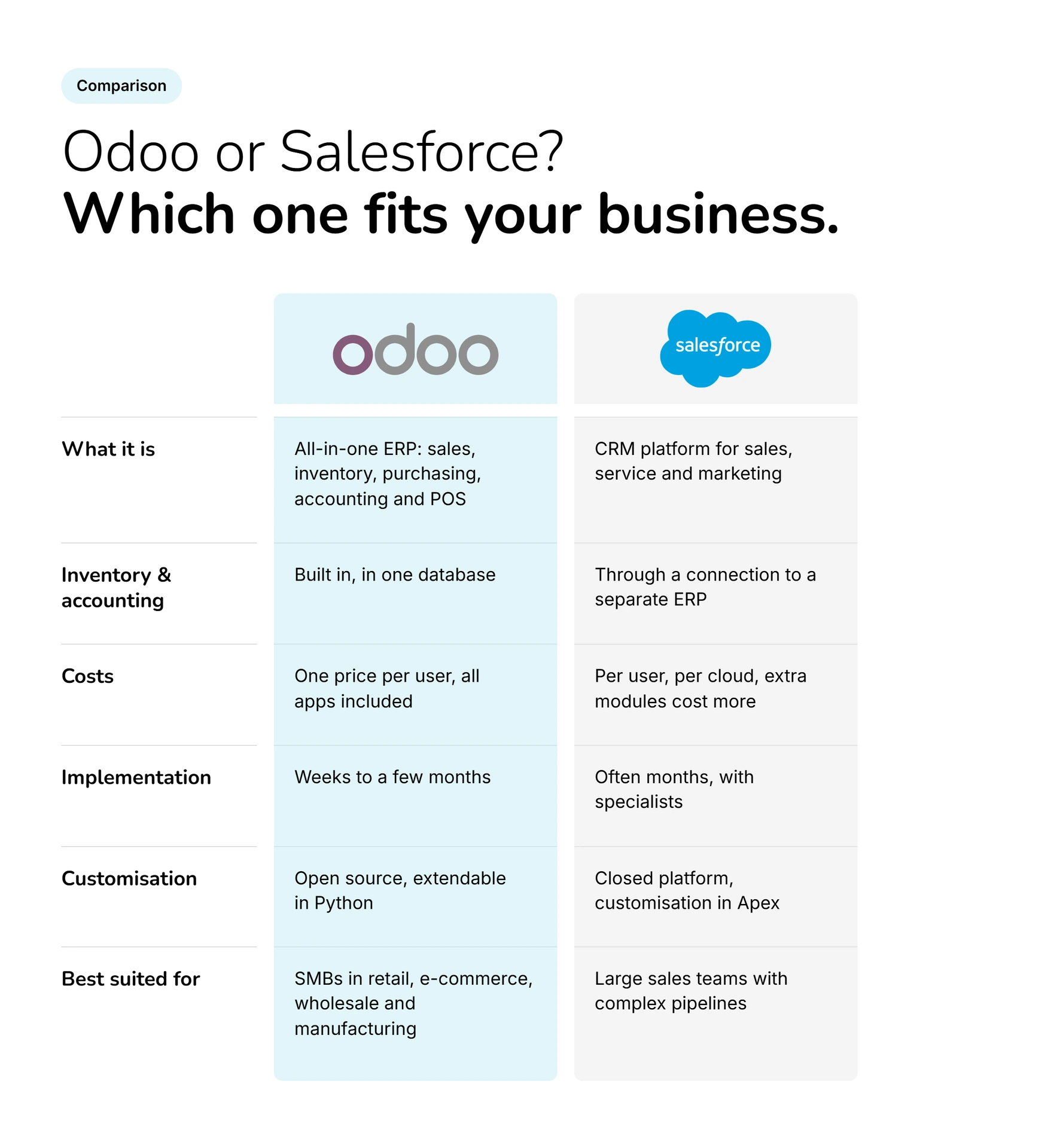
Here is where the comparison gets concrete. Odoo's Custom plan, at roughly €45 per user per month, includes CRM plus accounting, inventory, HR, a website, and everything else Odoo offers, for one fee. To match that same functional scope in Salesforce, a business typically needs more than one Cloud product, each billed separately, plus a separate accounting or ERP system entirely, since Salesforce does not include general ledger accounting or inventory management the way Odoo does. That is usually where the total cost gap opens up, not in the base CRM price itself.
Setup and Admin Work: Where the Real Cost Hides
Neither platform is a five-minute setup once you go beyond the free or entry tier, and it is worth being honest about that rather than pretending one is effortless. Salesforce's complexity mostly lives in the platform and customization layer. Anything beyond basic configuration commonly involves Apex code, flow builders, and admins who hold Salesforce certifications, which is a well-documented pattern across independent reviews and Salesforce's own admin community.
Odoo's complexity mostly lives in scoping. Because Odoo bundles dozens of apps, the real setup work is deciding which ones you actually need, configuring the automation rules and approval flows for your specific business, and migrating your existing data cleanly. For a single-app rollout, an internal team can often manage this. For a multi-app rollout with real business logic (say, CRM plus accounting plus inventory, all talking to each other), most businesses bring in an implementation partner to scope it properly and avoid rebuilding it a year later.
Where Salesforce Still Has an Edge
Salesforce still leads in a few specific areas. Its AppExchange marketplace has thousands of third-party add-ons built over two decades, its sales forecasting and territory management tools are built for very large, complex sales organizations, and its ecosystem of certified consultants and integrators is larger than Odoo's, simply because it has existed longer at enterprise scale.
Where Odoo Tends to Win
Odoo tends to win on a few different things. Pricing is a single, predictable number instead of a stack of separate product bills. Setup is usually faster for a small or mid-sized business because there is one system to configure, not several to connect. And because Odoo's core is open source, you are not locked into one vendor's proprietary data model if you ever want to move away. That combination is also why Odoo comes up so often as a Salesforce alternative for businesses that outgrew a single-purpose CRM.
Who Should Pick Which
Odoo usually fits better, and tends to work out as the best CRM for a growing business, if you are a company of roughly 5 to 200 people that needs sales, invoicing, inventory, and a website under one roof, and you do not want to hire a dedicated Salesforce administrator just to keep the system running.
Salesforce may still be worth the price if you are a large enterprise where the sales team is the entire product, sales is the only function you need software for, and budget is genuinely not the limiting factor.
A Checklist Before You Decide
- What apps do you actually need beyond CRM this year, and next year?
- Do you have, or are you willing to hire, the admin or developer capacity to keep the platform running?
- What is the realistic total cost at your current headcount, and at twice that headcount?
- Who is handling the data migration, and how long will it realistically take?
- What happens to your data and workflows if you ever need to switch providers?
Not Sure Which Fits? Get Your Requirements Mapped to Odoo
Picking between Odoo and Salesforce is easier once someone maps your actual requirements onto what Odoo can do, not just the pricing pages. dooPartners works with Odoo implementations across a network of specialist partners, and can walk you through what a real Odoo setup would look like for your business, including a straight comparison against your current Salesforce cost.
You can find a partner in your region and get a scoped answer, not a sales pitch, at:
dooPartners.com/for-businesses#find.
FAQ: Odoo vs Salesforce
Is Odoo cheaper than Salesforce?
In almost every case, yes, especially once you look beyond CRM alone. Odoo's Custom plan starts at roughly €45 per user per month and includes CRM plus accounting, inventory, HR, and more under one fee. Matching that same scope in Salesforce usually means buying multiple separate Cloud products plus a separate accounting system, which typically costs more in total than Odoo's single price.
Can Odoo replace Salesforce for CRM?
For most small and mid-sized businesses, yes. Odoo's CRM app covers pipeline management, lead scoring, email integration, and reporting, which covers what most sales teams actually use day to day. Very large, highly complex enterprise sales organizations with heavy customization needs may still find Salesforce's depth worth the extra cost.
Does Odoo have the same features as Salesforce CRM?
Not an identical feature list, but the core sales workflow is covered by both: pipeline stages, activity tracking, email sync, quotes, and reporting. Salesforce has a larger add-on ecosystem through AppExchange and more mature tools for very large sales teams. Odoo includes CRM as part of a wider business suite instead of as a standalone product.
Is Salesforce better for large enterprises?
Often yes, specifically for organizations where the sales function alone is large and complex enough to justify a dedicated platform, and where budget is not the main constraint. For businesses that also need accounting, inventory, or other operations software, Odoo's all-in-one model usually covers more ground for less total cost.
How long does it take to switch from Salesforce to Odoo?
It depends mainly on your data volume and how customized your current Salesforce setup is. A straightforward CRM data migration for a small team can take a few weeks. A full switch that also replaces other systems (accounting, inventory) with Odoo's built-in apps takes longer and is where working with an implementation partner usually pays for itself, since they scope the migration up front instead of finding gaps mid-project.