
You see cash flow in time when receivables, payables and the bank live in one ledger with a connected bank feed, read as an aged and forward view instead of a balance tile. Everything below is how to get that view and what deciding blind costs in the meantime.
It is the third week of the month and you are deciding whether to commit to a large stock order. You think the cash is there. You are not sure. The bank balance on your screen does not tell you, because it does not know about the three big invoices you sent that are not paid yet, the supplier bills due on the 28th, or the VAT you owe next week. So you go with your gut, place the order, and ten days later you are scrambling to delay a payment because the money you counted on was already spoken for.
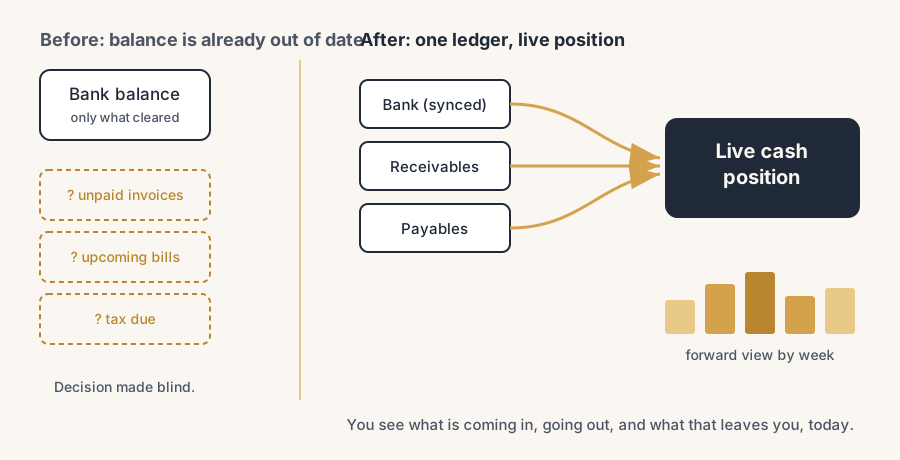
This is the problem of cash flow you cannot see until it is too late. The numbers exist, but they arrive weeks after they would have helped. You have no live view of what is coming in, what is going out, and what that leaves you. The cost is not the late report itself. It is every decision made on a balance that was already wrong: the order you should not have placed, the payment that went out before the receivable came in, the growth you held back on because you could not see the room. A connected system fixes this by keeping cash, receivables and payables in one ledger that updates as the work happens, so the number on your screen is the number that is true today. The blind spot is usually not laziness but a single tool standing apart: we described a client with a slick Shopify-to-3PL setup whose purchasing lived in Excel, which made the cashflow forecast guesswork, in your business has outgrown spreadsheets.
Why your cash picture arrives too late
A bank balance is a snapshot of the past. It tells you what cleared, not what is committed. Real cash flow is the balance plus everything that is going to move: the invoices customers still owe you, the bills you still owe suppliers, the tax due, the payroll on the 25th. When those pieces live in different places, nobody can see the whole picture in time to act on it.
Three things usually break it.
The data is scattered across systems. Sales sit in one tool, purchasing in another, invoices in a third, and the bank in a fourth. Each one knows its own piece. To see your real cash position you would have to pull all of them together and net them out by hand, which is exactly why it only happens at month-end, if at all.
Numbers arrive in batches, not as they happen. Invoices get entered in a weekly run. Bills get keyed in when someone has time. The bank statement gets imported and reconciled once a fortnight. So the "current" balance you look at is a composite of things that are days or weeks old, and the gaps are exactly where the surprises hide.
Nobody owns the forward view. Even when the books are clean, they look backward. What you owe and are owed in the next 30, 60, 90 days sits in invoice due dates that nobody has lined up against the calendar. The forward view, the one that would actually change a decision, does not exist as a report. It lives in someone's head, and heads forget the bill due on the 28th.
What the blind spot costs
The damage from invisible cash flow is rarely one dramatic event. It is a slow tax on every decision.
You hold cash you do not need to, because you cannot see that three large receivables land next week, so you sit on a buffer and pass on the stock deal that would have paid for itself. Or the opposite: you spend cash you do not have, because the balance looked healthy and you could not see the supplier run and the VAT both hitting on the same day. You chase the wrong customers, because you do not know which receivables are 60 days overdue and quietly turning into a problem. And when the bank or an investor asks for a forecast, you spend two days building one in a spreadsheet that is stale the moment you send it.
None of these show up as a line item. They show up as a business that runs more cautiously and more expensively than it needs to, because the people making the calls cannot see the cash in time.
How one connected system gives you a live picture
The fix is not a smarter spreadsheet or a faster bookkeeper. It is removing the gaps between the systems so the cash picture is already assembled. When sales, purchasing, invoicing and the bank feed live in one ledger, the events that move cash are recorded once and show up everywhere, including the forward view, as they happen.
Put it in one ledger.
When invoices, bills, payments and bank lines all live in the same accounting system, your receivables, your payables and your bank position are three views of the same data, not three exports waiting to be reconciled. This is the step that makes everything below it possible. There is no "current cash" report to assemble because the system already holds every piece in one place.
Connect the bank feed so the balance is current.
Set up Odoo's bank synchronization so transactions import automatically (every twelve hours by default, and on demand with Fetch Transactions). Your reconciled bank position then reflects what actually cleared without anyone keying in a statement. Note the honest detail: this is near-current, not literally to-the-second, because banks release transactions on their own schedule.
See receivables and payables aged, not just totalled.
Use the Aged Receivable and Aged Payable reports. These do not just tell you how much is owed, they tell you how late it is, bucketed by 30, 60, 90 days and beyond. Now you can see the 120,000 in receivables is mostly fine, except for one customer at 75 days who needs a call today, and that your payables cluster at month-end. This is the difference between a number and a decision.
Read the forward view, not just the past.
Odoo's Forecast future bills to pay lines up your upcoming vendor bills against expected dates, and the Cash Flow Statement shows inflows and outflows over a period. Together with the aged reports, you get the forward picture the spreadsheet used to fake: what is due to come in, what is due to go out, and what that leaves you, by week.
Let the dashboard be the answer, not the starting point.
With the data together and the bank feed connected, the accounting dashboard is your live cash position. Instead of asking someone to "pull the numbers" and waiting two days, you open the dashboard and the answer is there, current to the last sync. The decision gets made on a real number while it still matters.
The part that trips people up
A few things catch almost everyone
Connecting the systems is the easy half. The cash picture only becomes trustworthy if the discipline behind it is right, and this is where most "we have Odoo but I still cannot see my cash" stories come from.
A live picture is only as fresh as your entry discipline. If invoices and bills do not get entered when they happen, the forward view is missing exactly the items that would change the decision. The dashboard cannot show you a bill that is sitting in someone's inbox. The system makes the picture instant, but only for the data you actually put in.
Bank sync is not real time, and unreconciled lines lie. Synchronization runs on the bank's schedule, not the second a payment lands, so treat it as near-current. And imported bank lines only become a true position once they are reconciled against invoices and bills. A pile of unmatched transactions is not a cash picture, it is homework. Keep reconciliation current or the balance drifts.
The forecast needs due dates and payment terms set correctly. The forward view is built from invoice and bill due dates and your customers' and suppliers' payment terms. If those are blank, wrong, or everyone is set to "immediate", the forecast bunches everything on the invoice date and tells you nothing. The setup that makes the forecast honest is payment terms on partners and accurate due dates on documents.
Quick checklist
- Can you see your real cash position today, including unpaid invoices and upcoming bills, without waiting for the close?
- Is your bank feed connected and reconciled, so the balance reflects what actually cleared?
- Do you have aged receivables and payables, so you can see what is overdue and by how long, not just the totals?
- Can you see what is due to come in and go out over the next 30, 60, 90 days?
- Are sales, purchasing, invoicing and the bank in one ledger, or stitched together by hand at month-end?
- Are payment terms and due dates set correctly, so the forecast reflects reality?
FAQ
Can Odoo show me a real-time cash flow position?
Odoo gives you a near-real-time cash picture when sales, purchasing, invoicing and the bank feed live in one ledger. Bank synchronization imports transactions automatically (every twelve hours by default, and on demand), the Aged Receivable and Aged Payable reports show what is owed and how late, and the Cash Flow Statement and Forecast tools show what is coming in and out. It is not literally to-the-second, because banks release transactions on their own schedule, but it is current enough to decide on.
What is the difference between my bank balance and my real cash position?
The bank balance is what has cleared. Your real cash position is that balance plus everything committed: unpaid customer invoices coming in, supplier bills and tax going out, payroll due. A connected system keeps all of those in one place so you can see the real position, not just the past snapshot the bank shows.
How does Odoo help me forecast cash flow?
Odoo's Forecast future bills to pay lines up upcoming vendor bills by date, the Cash Flow Statement reports inflows and outflows over a period, and the Aged Receivable report shows when customer payments are due. Together these give you a forward view by week or month. The forecast is only as accurate as the due dates and payment terms behind it, so those have to be set correctly first.
Why are my Odoo cash numbers still wrong even though I have Odoo?
Usually because invoices and bills are not entered as they happen, the bank feed is not reconciled, or payment terms and due dates are missing. Odoo can show a live cash picture, but only for the data you put in and keep reconciled. Fix the entry discipline and the reconciliation, and the dashboard becomes a number you can trust.
Do I need a separate tool for cash flow forecasting?
For most mid-market companies, no. Odoo's aged reports, Cash Flow Statement and bill forecast cover the forward view when accounting, sales and purchasing are in the same system. A dedicated treasury tool can add value for complex, multi-bank, multi-currency cash management, but the core "what is coming in, what is going out, what does that leave me" question is answered inside Odoo once it is set up correctly.