
You get investment-ready by running the business on one ledger where every number reconciles and every process leaves a trail, long before anyone signs a letter of intent. A buyer pays for what they can verify, and verification starts in your system, not in your pitch deck.
An investor signs the letter of intent, and a week later their analyst sends a list of forty questions. Revenue by product line for the last three years. The bridge between your sales system and your bank. Which customers churned and when. Your real gross margin per quarter. You start pulling the numbers and they do not agree. The webshop says one revenue figure, the accounting export says another, and nobody can explain the gap without a meeting. The data room that was supposed to take two weeks takes two months, and every delay gives the other side a reason to ask for a lower price or a longer earn-out.
This is the moment most owners discover that their numbers and their processes are a mess, and that the mess has a price. A buyer or an investor does not pay for what you say the business is worth. They pay for what they can verify. When the figures do not reconcile, when the process behind a number cannot be traced, and when every answer needs a person to reconstruct it by hand, the deal does not just slow down. The risk gets priced in, and the price comes off your valuation. The fix is not a frantic clean-up the month before due diligence. It is running the business on one system where the ledger is clean, the processes are traceable, and the reporting is reliable long before anyone asks to see them.
Why a messy back office lowers your valuation
A valuation is a bet on future cash flow, discounted for risk. Anything the other side cannot verify becomes risk, and risk is a discount on the price. Three things turn a back office into risk.
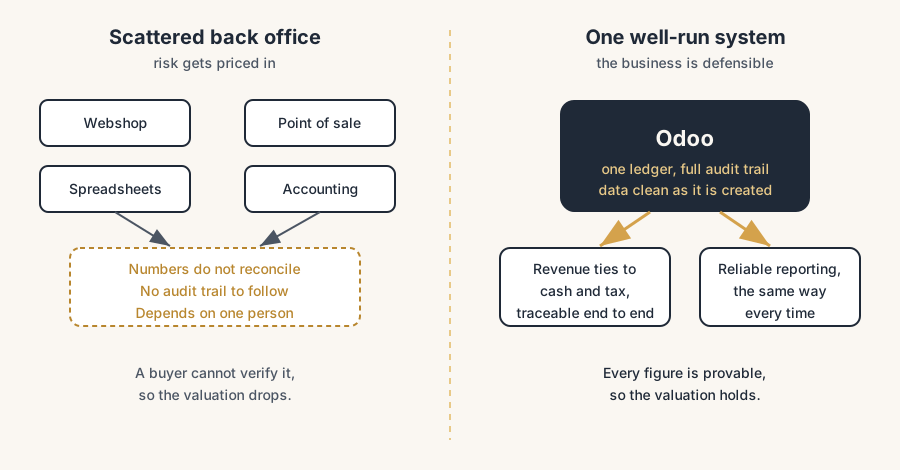
The numbers do not reconcile. Your webshop, your point of sale, your spreadsheets and your accounting each hold a piece of the truth and none of them agrees with the others. When revenue in one system does not tie to the cash in the bank, an analyst cannot trust any single figure. They either price in the uncertainty or send the question back, and both cost you.
The process behind a number cannot be traced. A due-diligence team does not only want the total. They want to follow one order from the quote, to the invoice, to the delivery, to the payment, and back to the ledger. If that trail lives in someone's memory, in email threads, or in a spreadsheet that gets overwritten, you cannot prove the number is real. An unprovable number is treated as an unreliable one.
The business runs on people, not on a system. If the only way to produce the monthly figures is one person who knows where everything is and how it all fits, the buyer is not buying a process, they are buying a dependency. That is a key-person risk, and it lowers the price or pushes it into an earn-out that keeps you tied in for years.
What due diligence actually checks
It helps to know what the other side is looking for, because it is more concrete than "the numbers". A financial and operational due diligence typically tests:
- Quality of earnings. Is the revenue real, recurring and recognised correctly, or is it inflated by one-off deals, timing tricks or numbers that cannot be tied to cash?
- Reconciliation. Does revenue tie to invoices, invoices to deliveries, and the whole thing to the bank statements and the VAT returns?
- Traceability. Can any figure be drilled down to the underlying transactions, with a date, a user and a document behind each one?
- Working capital and stock. Is the stock on the balance sheet actually there and valued on a consistent method, or is it a guess?
- Process and controls. Is there a repeatable process with an audit trail, or does everything depend on manual workarounds and one or two people?
Every one of those is easy to pass when the business runs on one connected system, and painful when it does not. The same checks apply whether the event is an investment, a sale, or a statutory audit. Get ready once and you are ready for all three.
How one well-run system makes the business defensible
The goal is simple: every number the other side asks for already exists, ties to its source, and can be produced without a heroics project. You get there by running the business on one system instead of stitching together exports the week before the deal. The steps below are the difference between a data room you dread and one you can open in a day.
Put the business on one ledger.
When sales, purchasing, stock and accounting live in the same system, revenue, cost and cash meet on the same records automatically. There is nothing to reconcile by hand because there were never separate islands. This is the step that makes every check below pass, because the numbers agree by construction, not by effort.
Make every process traceable end to end.
Configure the flow so each order carries its own trail: quote to sales order, to delivery, to invoice, to payment, each step stamped with a date, a user and a document. In Odoo this trail already exists. The chatter and the audit log on every record show who did what and when, so any figure can be drilled down to the transactions behind it. That is exactly what a due-diligence team wants to follow.
Tie revenue to cash and tax.
Invoice from the orders, book purchases against their bills, reconcile the bank feed against both, and let the VAT figures derive from the same transactions. When revenue ties to invoices, invoices to deliveries, and the lot to the bank and the tax return, your quality of earnings holds up because every line is provable.
Value stock on a method you can defend.
Set automated stock valuation with a deliberate cost method (standard, average or FIFO) so the stock on the balance sheet reflects real movements at real prices. A buyer trusts a stock figure that comes from a consistent, automatic method far more than one a person estimated at year-end.
Make reporting reliable and repeatable.
With the data together, your monthly and yearly reports come from the system, not from one person's spreadsheets. Revenue by product, by customer and by period, margin, working capital, all of it produced the same way every time. A buyer who sees consistent, system-generated reporting sees a business that runs on a process, not on a person.
Close the gaps that still feed numbers in by hand.
Any channel that someone re-keys manually (a webshop, a marketplace, a second tool) is a place where the numbers drift and the trail breaks. Connect those so the data flows in once and stays tied to its source. This is what keeps the ledger clean between today and the day the analyst arrives.
The part that trips people up
A few things catch almost everyone
Clean data is not a button you press the month before due diligence. The owners who sail through a deal are the ones who built the discipline in early, and these are the things that catch out the ones who did not.
A last-minute clean-up creates new questions, not fewer. Re-stating last year's numbers in the weeks before a deal is the fastest way to make a buyer nervous. Adjustments that appear right before due diligence look like exactly what they are: a problem someone is papering over. The data has to be clean as it is created, all year, not scrubbed at the end.
Turning on the system does not make the numbers true. Putting the business on Odoo gives you the trail and the reconciliation, but only if the setup is right. A wrong chart of accounts, a stock valuation method nobody chose on purpose, opening balances loaded carelessly, or analytic accounting missing where you need margin by segment, all produce reports that look clean and reconcile to nothing. The configuration is where a number becomes defensible or merely tidy.
Process changes during a deal undermine the trail. Changing how you book things, or how you value stock, in the middle of a due diligence breaks the consistency the buyer is testing for. The valuation method, the close process and the reporting have to be stable and applied the same way across the periods under review. Stability is itself a signal of a well-run business.
Key-person risk is a process problem, not a documentation problem. Writing a manual the week before the deal does not remove the dependency on the one person who knows where everything is. The dependency goes away when the process actually runs in the system, with roles, approvals and an audit trail, so the work does not live in anyone's head.
The less obvious balance items are where diligence bites. Owners prepare the revenue story and forget the quiet obligations. The list we walk through with every client before a deal: accrued holiday balances the team has not taken yet, deferred revenue on contracts you invoiced ahead, warranty and returns provisions, volume rebates earned but not yet invoiced either way, and deposits or guarantees held. None of these is exotic, every one of them must be on the balance sheet, and an analyst who finds one missing starts wondering what else is.
Quick checklist
- Does revenue in your operational systems tie to the cash in your bank, without a manual bridge?
- Can you follow one order from quote to payment, with a date and a user on every step?
- Are sales, purchasing, stock and accounting in one system, or stitched together by hand?
- Is your stock valued on a consistent, automatic method you can explain?
- Do your monthly figures come from the system the same way every time, or from one person's spreadsheets?
- If your key finance person left tomorrow, could someone else still produce the numbers?
- Are last year's books clean as they stand, or would you need to re-state them before a buyer looks?
FAQ
How do I get my company ready for due diligence?
Run the business on one connected system long before the deal, so the numbers already reconcile and every figure can be traced to its source. Due diligence tests quality of earnings, reconciliation, traceability, stock valuation and process controls. When sales, purchasing, stock and accounting sit in one ledger with an audit trail, those checks pass without a clean-up project, because the data was clean as it was created.
Why does messy data lower a company's valuation?
Because a valuation is priced for risk, and anything a buyer cannot verify becomes risk. If revenue does not tie to cash, if a number cannot be traced to its transactions, or if the figures only exist because one person assembles them by hand, the buyer prices in the uncertainty. That discount comes straight off the price, or pushes it into an earn-out.
What does due diligence actually look at?
A financial and operational due diligence checks whether revenue is real and correctly recognised (quality of earnings), whether revenue ties to invoices, deliveries and the bank, whether any figure can be drilled down to its underlying transactions, whether stock is valued consistently, and whether there is a repeatable process with an audit trail rather than manual workarounds.
Can I just clean up the data right before the deal?
You can, but it works against you. Re-stating numbers in the weeks before due diligence makes a buyer nervous and invites more questions, not fewer. The data has to be clean as it is created, across the whole period under review. That is why getting the system right is something to do well ahead of any deal, not during it.
Does putting the business on Odoo make it investment-ready by itself?
Not on its own. Odoo gives you one ledger, an audit trail and reconciliation, which are the foundation. But the numbers are only defensible if the setup is right: the cost method, the chart of accounts, the opening balances and the analytic accounts have to be chosen and loaded deliberately. A correct configuration is the difference between reports that are clean and reports that merely look clean.